
Table of Contents
- What You'll Need Before You Organize Kitchen Drawers
- How to Declutter Kitchen Drawers the Right Way
- Best Kitchen Drawer Organizers for Small Spaces
- DIY Drawer Dividers: Budget-Friendly Fixes That Work
- Step-by-Step: How to Organize Small Kitchen Drawers by Type
- Ergonomic Workflow Mapping and Accessibility Tips
- Common Mistakes to Avoid When Organizing Kitchen Drawers
- Conclusion
Last Updated: August 18, 2026
What You'll Need Before You Organize Kitchen Drawers
The most common reason reorganization efforts fail is jumping straight to buying products without a clear plan. Gather what you need first, and the whole process becomes faster and far less frustrating.
Here's what to have on hand before you start:
- A tape measure (metric and imperial markings)
- Painter's tape and a marker for labeling
- A notepad or phone for recording measurements
- Trash bags and donation boxes for the purge phase
- A clean surface nearby to sort items
Check your drawer weight capacity before loading it back up. Drawers in standard kitchen cabinetry are typically rated for 75 to 100 pounds, but older or budget cabinetry may handle significantly less. Overloading a drawer puts stress on the slides and can cause full-extension drawers to fail. If you notice a drawer already dragging or sagging, address the hardware before adding organizers.
Decide in advance which kitchen zones you're optimizing for. Cooking tools belong near the stove. Cutlery belongs near the dining area or dishwasher. Baking tools can live in lower-traffic drawers. Mapping your kitchen workflow before you touch anything saves you from reorganizing twice.

How to Declutter Kitchen Drawers the Right Way
Empty one drawer completely onto your sorting surface. Do not move to the next drawer until this one is resolved. Multitasking the declutter phase creates chaos.
Sorting by Category and Frequency of Use
Sort every item into four groups: keep, relocate, donate, and discard. The "relocate" pile is critical, many items end up in the wrong drawer simply because that's where they landed after unpacking.
For the "keep" pile, apply a frequency filter:
- Daily use: Must be in the most accessible drawer, front and center
- Weekly use: Can go in a secondary position within the same drawer
- Monthly or less: Belongs in a deep drawer, a cabinet shelf, or storage
According to The National Kitchen and Bath Association's kitchen planning guidelines, items used most frequently should be stored closest to their point of use. Pick the best one of each duplicate item and let the rest go. A clutter-free drawer is faster to use.
Measuring Drawer Dimensions Before You Buy Anything
Buying organizers before measuring is the single biggest source of wasted money in kitchen organization projects.
Measure the following for every drawer:
- Interior width (side to side, inside the drawer box)
- Interior depth (front to back, inside the drawer box)
- Interior height (from the bottom of the drawer to the underside of the countertop above, when the drawer is open)
- Drawer box depth (how deep the actual box is, which limits how tall your inserts can be)
Write these down. A difference of half an inch can mean an expandable divider won't extend far enough or a modular insert won't sit flat. Shallow drawers under 2.5 inches deep need low-profile bins. Deep drawers over 5 inches can accommodate vertical storage solutions.
Best Kitchen Drawer Organizers for Small Spaces
The best kitchen drawer organizers for small spaces are ones that match your exact measurements, not the ones that look best in a lifestyle photo. The organizer market broadly splits into three categories: expandable inserts, modular organizers, and fixed trays.
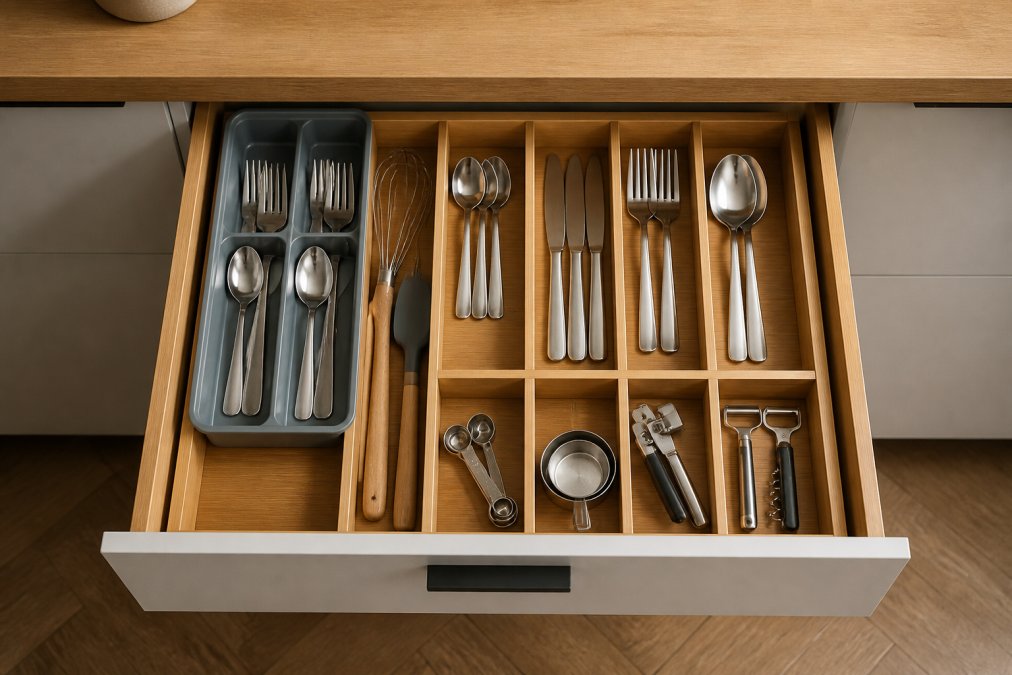
Expandable Dividers and Modular Inserts
Expandable dividers are the most versatile solution for non-standard drawer sizes. They use a spring-loaded or sliding mechanism to extend across the drawer width, creating customizable compartments without cutting or gluing. They're particularly effective in shallow drawers where you need to compartmentalize without adding height.
Modular inserts work differently. Individual bins slot together in a customizable layout, giving you more flexibility if your kitchen inventory changes seasonally or if you share a kitchen with someone who has different organizational preferences.
| Organizer Type | Best For | Drawer Depth | Flexibility |
|---|---|---|---|
| Expandable dividers | Non-standard widths | Shallow to medium | High |
| Modular inserts | Custom layouts | Medium to deep | Very high |
| Fixed utensil tray | Cutlery, daily tools | Shallow (2-3 in) | Low |
| Vertical storage bins | Deep drawers | Deep (5+ in) | Medium |
For tight spaces where standard inserts don't fit, look for drawer inserts designed specifically for narrow drawers, typically under 9 inches wide.
Acrylic, Bamboo, and Non-Slip Liner Options
Acrylic organizers are easy to clean, visually clean-looking, and durable. They show water spots and crumbs quickly, which is useful if you prefer to notice when a drawer needs attention.
Bamboo dividers are a strong choice if sustainability matters to you. Bamboo is a rapidly renewable material and typically more rigid than plastic equivalents. They're less moisture-resistant than acrylic, so avoid them in drawers near the sink where condensation is common.
Non-slip liners prevent the entire organizer system from shifting every time the drawer is opened. Cut them to size using your drawer measurements. Drawer liners also protect the drawer box from scratches and moisture damage, extending the life of your cabinetry.
DIY Drawer Dividers: Budget-Friendly Fixes That Work
DIY drawer dividers work well for specific situations, particularly for very narrow drawers or unusually shaped spaces where off-the-shelf products don't fit.
The most effective DIY options:
-
Foam board strips cut to drawer height and secured with hot glue. Lightweight, easy to reconfigure, and costs almost nothing.
-
Repurposed small boxes (tea boxes, jewelry boxes, or spice containers without lids). These create instant compartments and are easy to swap out as your kitchen inventory changes.
-
Tension rods placed vertically or horizontally across a drawer. Particularly useful for organizing baking sheets, cutting boards, or lids in deeper drawers.
-
Cardboard wrapped in contact paper. Cut strips to the drawer's interior height, score and fold tabs at the base to keep them upright, and create a fully custom grid in about 20 minutes.
The limitation of DIY solutions is durability under heavy use. A drawer you open 15 times a day will wear through foam board dividers faster than a drawer you open twice. For high-traffic drawers, invest in a proper insert.
Step-by-Step: How to Organize Small Kitchen Drawers by Type
Match your strategy to the drawer type. A one-size approach produces mediocre results.
Utensil and Cutlery Drawers
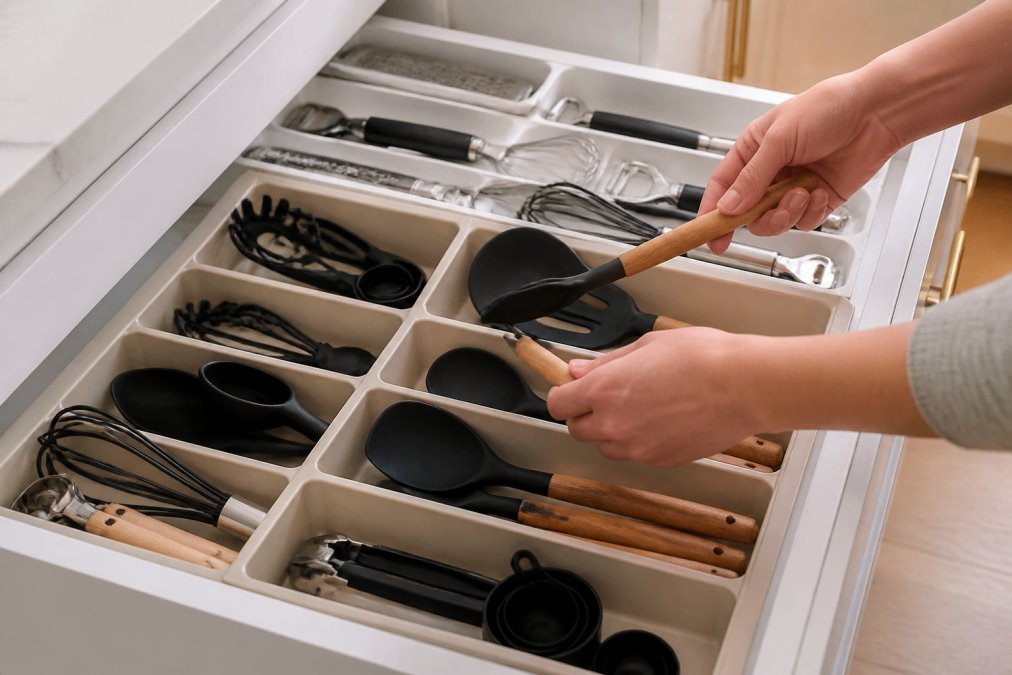
The utensil drawer is typically the most chaotic in any kitchen. The fix is a dedicated utensil tray with distinct compartments.
Follow this sequence:
- Empty the drawer completely and wipe it down
- Place a non-slip liner cut to the exact drawer dimensions
- Set your utensil tray or modular inserts in position
- Group cutlery by type: forks together, knives together, spoons together
- Place daily cooking tools (spatulas, tongs, ladles) in the largest compartment
- Fill remaining compartments with secondary tools by frequency of use
- Leave one compartment empty as a buffer zone for new additions
CrispNest's 14-Piece Silicone Kitchen Utensils Set stores cleanly in a standard utensil tray without the handles overlapping, which is a common problem with bulkier stainless steel sets. Each piece has a consistent handle length, making drawer organization significantly easier.

Deep Drawers vs. Shallow Drawers
Shallow drawers (under 3 inches deep) work best with flat, low-profile inserts. Prioritize items that lie flat: cutlery, measuring spoons, small gadgets. Avoid stacking anything in a shallow drawer.
Deep drawers (5 inches or more) offer the opportunity for vertical storage. Use bins or dividers tall enough to keep items upright. Pot lids, cutting boards, and baking pans stored vertically in a deep drawer are far easier to retrieve than items stacked flat. According to University of Wisconsin Extension's home storage guidelines, vertical storage in deep kitchen drawers reduces retrieval time and reduces the risk of items falling and causing injury.
Narrow Drawers and Tight Spaces
Narrow drawers under 9 inches wide are the hardest to organize because most standard products don't fit. A few approaches that actually work:
- Single-row expandable inserts designed for cutlery trays
- Small acrylic bins placed side by side
- Tension rods oriented front-to-back to create vertical dividers
For accessibility, keep the narrowest drawers at a height between hip and shoulder level. Items stored below knee height or above shoulder height in narrow drawers are significantly harder to retrieve for people with limited mobility or joint pain.
Ergonomic Workflow Mapping and Accessibility Tips
Most kitchen organization guides focus entirely on aesthetics. Ergonomic workflow mapping focuses on function: how your body moves through the kitchen, and how your drawer configuration either supports or fights that movement.
Every item should be stored at the point of first use. If you reach for a spatula while standing at the stove, the spatula drawer should be within arm's reach of the stove, not across the kitchen.
Map your kitchen workflow before finalizing any drawer configuration:
- Walk through your three most common cooking routines
- Note where you naturally reach for items
- Identify any moment where you have to cross the kitchen to retrieve something
- Reassign those items to a drawer closer to their point of use
For people with limited mobility or arthritis, drawer organization choices have a direct impact on safety and independence. As documented in ADA accessibility guidelines for residential kitchens, accessible kitchen design recommends storing frequently used items between 15 and 48 inches from the floor. Full-extension drawers that pull out completely are far more accessible than standard drawers that only open 75%, because they eliminate the need to reach deep into the drawer.
Heavy items like cast iron tools or large serving utensils should always go in lower drawers, both for ergonomic access and to stay within the drawer's weight capacity.

Common Mistakes to Avoid When Organizing Kitchen Drawers
Buying organizers before measuring. A drawer organizer that doesn't fit is worse than no organizer at all because it creates awkward gaps where items slide and collect debris.
Organizing around items you should have discarded. If you didn't use the egg separator in the past year, organizing it neatly into a compartment doesn't make you more likely to use it.
Ignoring drawer liner maintenance. Drawer liners should be removed and cleaned every three to six months. Crumbs and moisture accumulate underneath them and can damage the drawer box over time.
Treating the organization as permanent. Your kitchen inventory changes. Revisit your drawer organization system every 12 months and adjust.
Overloading drawers past their capacity. A drawer that's difficult to open or close is a sign it's overloaded, not a sign you need a bigger organizer. Redistribute items to other drawers or storage areas.
Skipping the deep drawer vertical strategy. Deep drawers used for flat storage are half as efficient as they could be.
For additional guidance on sustainable storage choices, the EPA's Sustainable Materials Management resources offer practical frameworks for reducing household waste through smarter product selection, which applies directly to choosing durable, long-lasting drawer organizers over disposable solutions.
| Mistake | Fix | Impact |
|---|---|---|
| Buying before measuring | Measure all dimensions first | Eliminates wasted purchases |
| Keeping unused items | Apply frequency filter ruthlessly | Frees 20-40% more drawer space |
| Ignoring liner maintenance | Clean liners every 3-6 months | Protects drawer box longevity |
| Flat storage in deep drawers | Use vertical bins and dividers | Doubles usable storage capacity |
| Overloading drawers | Redistribute to cabinets or shelves | Protects drawer hardware |
Frequently Asked Questions
What is the best way to organize a small kitchen drawer?
Start by removing everything and sorting items by category and how often you use them. Measure the drawer's interior width, depth, and height before buying any organizers. Use expandable drawer dividers or a customizable modular insert to create dedicated compartments for cutlery, utensils, and small tools. Keep daily-use items in the front sections and store less-used items toward the back. A non-slip liner on the drawer base prevents everything from shifting during use.
How do you maximize space in a small kitchen drawer?
Vertical storage is the most underused strategy in small drawers. Shallow bins stacked inside a deep drawer, or a utensil tray with tiered compartments, can double the usable space. Expandable inserts that custom-fit the drawer width eliminate wasted gaps at the sides. Removing duplicate tools and items you rarely reach for also frees more room than any organizer will. A clutter-free drawer with fewer, well-chosen tools is always more functional than a full one with poor organization.
What can I do with a very narrow kitchen drawer?
Narrow drawers work best for flat, single-layer items: drawer liners, sandwich bags, aluminum foil rolls, or a row of measuring spoons hung on a small tension rod. Acrylic organizers cut to size or thin bamboo dividers can compartmentalize a narrow drawer without wasting space. Avoid overfilling narrow drawers, since overcrowding prevents full-extension access and makes it harder to find what you need quickly.
Are DIY drawer dividers worth it compared to buying organizers?
DIY drawer dividers are worth it for non-standard drawer sizes where off-the-shelf inserts don't fit. Foam board, balsa wood strips, or tension-rod dividers cost very little and can be cut to exact measurements. For standard-sized drawers, a quality modular organizer or expandable insert from a home goods retailer often saves time and looks cleaner. The best approach depends on your drawer configuration and how much customization you actually need.
Disorganized kitchen drawers create friction in every meal you cook. CrispNest's curated selection of kitchen utensil sets, including the 14-Piece Silicone Kitchen Utensils Set, is designed with consistent handle sizing and clean silicone construction that slots neatly into standard drawer organizers. Pair them with the right drawer configuration from this guide and you'll have a kitchen setup that genuinely works. Add to cart and start building a kitchen that works as well as it looks.
This article was written using GrandRanker


