
Table of Contents
- Assess Your Space and Plan Your Layout
- Choose Space-Saving Workout Equipment
- Home Gym Organization Ideas for Compact Areas
- Select Small Home Gym Flooring Options
- Budget-Friendly Setup and Cost Considerations
- Design Your Workout Space with Acoustic and Structural Safety
- Common Mistakes to Avoid When Building a Small Home Gym
- Conclusion
Last Updated: August 20, 2026
Assess Your Space and Plan Your Layout
Measure your available square footage carefully, most people overestimate by 20-30%, leading to cramped setups. Grab a tape measure and note exact dimensions, ceiling height, door swing radius, and immovable obstacles like radiators or shelving.
Decide on your workout style: strength training, cardio, yoga, or a mix. This determines equipment footprint. A kettlebell and resistance band setup takes minimal space; a treadmill demands dedicated real estate. At CrispNest, we offer a thoughtfully curated selection of fitness products to help customers find gear that aligns with their fitness priorities.
Create a rough floor plan on paper or digitally, marking where equipment will live when not in use and where you'll actually work out. Consider traffic flow: can you move freely without tripping over gear? Natural light and sightlines matter too, a home gym in a well-lit corner feels larger and more motivating than one hidden behind a door. If your space is dark, plan for task lighting; it costs little but transforms the room's feel.
Choose Space-Saving Workout Equipment
Adjustable dumbbells and resistance bands
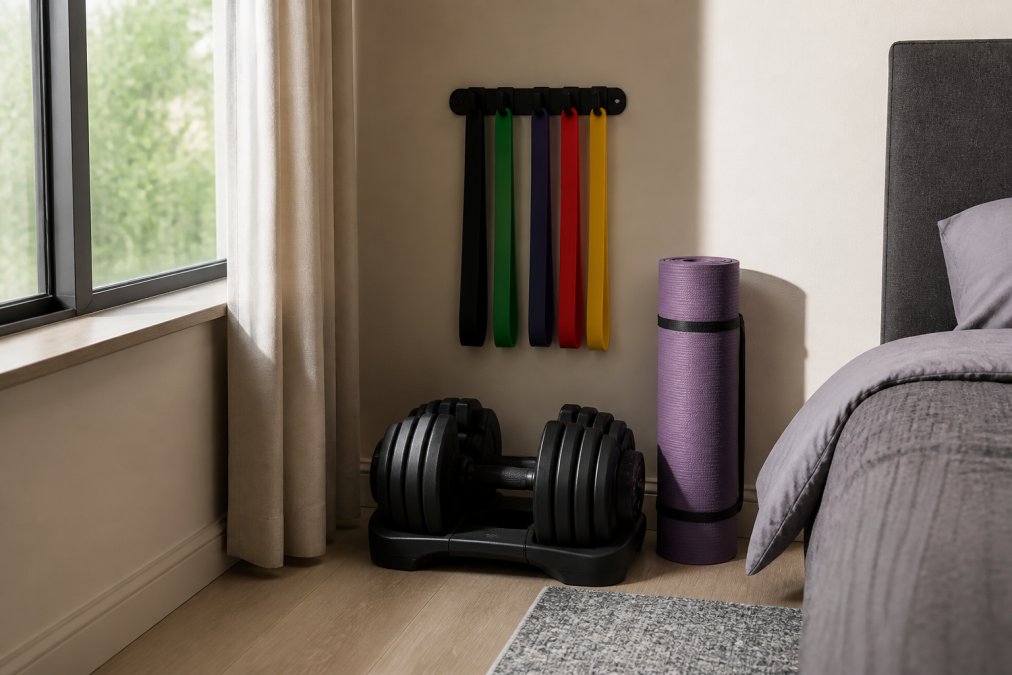
Adjustable dumbbells are the single best investment for small-space strength training. A single set replaces 15-20 traditional dumbbells, cutting your storage footprint by 90%. They stack vertically or fit under a bed, and you adjust weight with a dial or pin. Most people benefit most from adjustable dumbbells because they deliver full-body strength work in minimal floor area.
Resistance bands cost almost nothing and take up roughly the size of a rolled-up yoga mat. They're ideal for upper body work, mobility training, and supplemental exercises. Unlike dumbbells, bands don't require floor space during use, anchor them to a door frame or wall hook. The combination of adjustable dumbbells plus resistance bands covers 80% of strength training needs. Add a pull-up bar and you've built a legitimate strength-training setup in roughly 20 square feet.
Foldable and multi-functional gear
Foldable equipment is a smart choice for anyone serious about consistency. A foldable bench provides critical back support for pressing movements and stores in a closet. Foldable squat racks and pull-up bars mount to door frames and store flat. Setup takes 2-3 minutes, a reasonable trade-off for space savings.
Multi-functional equipment does double or triple duty. A weight bench that folds also serves as a step platform for cardio. A power rack with pull-up bar handles dips, rows, and assisted pull-ups. These tools are expensive upfront but eliminate the need to buy five separate pieces. Yoga mats, foam rollers, and suspension trainers occupy almost no space and are genuinely useful for mobility work, core training, and active recovery.
Home Gym Organization Ideas for Compact Areas
Vertical storage and wall-mounted solutions
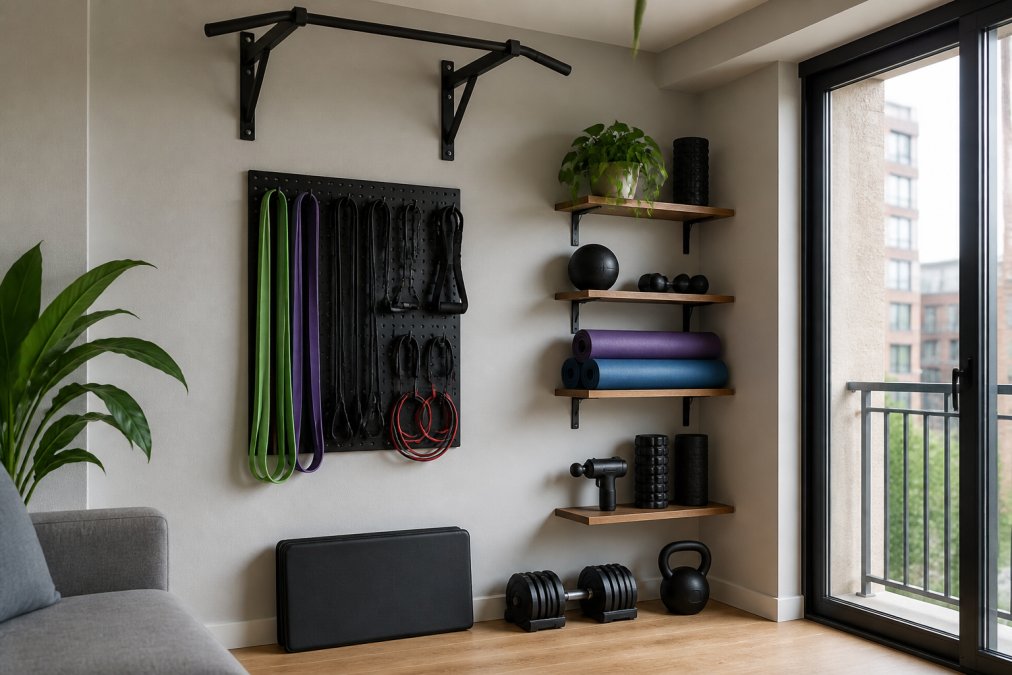
Vertical storage is your secret weapon. Wall-mounted hooks, pegboards, and shelving systems use unused wall space. Resistance bands, jump ropes, and towels hang on hooks. Dumbbells rest on wall-mounted racks. A pegboard system organizes smaller items like resistance loop bands, lacrosse balls, and recovery tools in one visible area. Seeing your gear organized makes the space feel intentional rather than cluttered.
Pull-up bars mounted in doorframes serve triple duty: pull-ups, hanging knee raises, and a clothes hanger when not training. They're inexpensive and require no floor space. Wall-mounted shelving holds folded yoga mats, rolled towels, and recovery equipment. Keep everything at or above eye level; lower storage makes small spaces feel cramped. Coil resistance bands and power cords neatly to prevent visual chaos.
Cubby systems and under-bed storage
Cubby systems are modular storage units that stack and reconfigure. Each cubby holds a folded yoga mat, a set of resistance bands, or a coiled jump rope. Because they're modular, you can add or remove cubbies as your equipment collection grows. They're affordable and look cleaner than loose gear piled in a corner.
Under-bed storage works if you're not doing multiple training sessions per day. Flat resistance band sets, yoga mats, and folded benches fit neatly under a standard bed frame. Vacuum storage bags compress bulky items like yoga mats and towels to one-third their original size, though you'll need to decompress items before use.
Select Small Home Gym Flooring Options
Rubber mats are the standard for good reason: they protect your floor from dumbbells, reduce impact noise, and provide stable footing. Interlocking rubber tiles let you cover only the area you need and expand later. A 4x6 foot mat costs less than a single month of gym membership and lasts 5+ years.
Foam mats are softer underfoot but less durable than rubber. They work well for yoga and low-impact training but don't handle heavy dumbbells well. For strength training with weights, rubber is non-negotiable.
Acoustic dampening matters in apartments. Rubber mats reduce impact noise by 40-50%. Some have acoustic backing specifically designed for sound reduction. A 0.75-inch mat is the practical middle ground for most home gyms. Check your floor's weight capacity before installing heavy equipment, especially important in apartments on upper floors.
Budget-Friendly Setup and Cost Considerations
A complete beginner setup, adjustable dumbbells, resistance bands, a yoga mat, and rubber flooring, costs less than three months of gym membership. Start with essentials and expand only after training consistently for 3-4 months, when you'll know which gaps actually matter.
CrispNest's curated approach focuses on offering high-quality, durable essentials. Premium equipment often lasts longer, providing better value over time. A quality adjustable dumbbell set can be a long-term investment. A quality mat can also offer extended durability.
Look for multi-functional equipment that serves multiple purposes. A weight bench that folds and doubles as a step platform is smarter than buying separately. A power rack with pull-up bar handles dips, rows, and pull-ups, three major exercises in one device.
Design Your Workout Space with Acoustic and Structural Safety
Acoustic dampening for apartments
Noise is the biggest barrier to home gym success in apartments. Dropping dumbbells, jumping during cardio, and heavy footsteps create vibrations that travel through floors and walls. Many apartment dwellers abandon their home gyms because they feel guilty about noise, this is preventable with proper planning.
Acoustic mats are the first line of defense. Rubber mats with acoustic backing reduce impact noise significantly. If you're doing jump training or explosive movements, acoustic mats are non-negotiable. A 4x6 foot acoustic mat costs less than $100 and prevents neighbor complaints that could cost your lease.
Sound-absorbing panels on walls reduce noise reflection. Strategic placement behind your main workout area and on the ceiling handles 60-70% of noise issues. Train during daytime hours and avoid early mornings or late evenings when sound travels further. This simple behavioral adjustment costs nothing and respects your neighbors.
Weight capacity and load-bearing limits
Apartment floors have weight limits, and installing heavy equipment or dropping dumbbells repeatedly can cause structural damage. Most apartment floors support 40-50 pounds per square foot as live load. Check your lease and building documentation for limits. Contact your landlord or building management if you can't find this information, this is a safety and legal issue.
Distribute weight across the largest possible area. Wall-mounted equipment spreads load across wall studs better than corner stacks. Never drop heavy weights repeatedly on apartment floors. Use bumper plates designed for dropping, or avoid dropping altogether. This is the fastest way to damage your apartment and face expensive repairs.
For houses with basements or ground floors, weight limits are less of a concern. Concrete floors handle heavy equipment well. Focus on ventilation and moisture control instead.
Common Mistakes to Avoid When Building a Small Home Gym
The biggest mistake is buying equipment before defining your actual workout routine. Before spending money, commit to a specific training style for 30 days. Do you actually enjoy strength training, or do you prefer cardio and mobility work?
The second mistake is underestimating storage needs. Proper storage is not optional, it's the difference between a functioning home gym and a cluttered bedroom. Invest in vertical storage, wall hooks, and organizational systems before buying equipment.
Ignoring acoustic and structural concerns is the third major mistake. Neighbors complain. Floors develop stress cracks. Leases get terminated. A small upfront investment in acoustic mats and weight distribution prevents these problems.
Buying too much equipment too fast creates chaos. Start with three core pieces and expand only when you've outgrown them. Finally, commit to training 3-4 times per week before investing. A beautifully designed home gym that sits unused is just expensive furniture.
Building a home gym in small space is entirely achievable with thoughtful planning and strategic equipment choices. Start small, prioritize consistency, and expand only when you've proven you'll actually use what you buy. CrispNest offers premium fitness essentials and home organization products designed for this challenge: creating functional, durable workout spaces in compact living areas. Browse our curated fitness collection to find equipment that matches your space and your training goals, and start building the home gym you'll actually use.
Frequently Asked Questions
What is the smallest space needed for a home gym?
You can build a functional home gym in as little as 50 square feet. This footprint accommodates a yoga mat, adjustable dumbbells, resistance bands, and a pull-up bar mounted on a wall. The key is vertical storage and multi-functional equipment that doesn't require floor space when not in use. Even a corner of a bedroom or living room works if you use wall hooks and foldable gear.
What are the best space-saving workout equipment options?
Adjustable dumbbells replace entire dumbbell racks and take up minimal space. Resistance bands provide full-body training without weight. Foldable yoga mats and pull-up bars that mount on door frames or walls eliminate storage needs. Kettlebells offer compound movements in a single piece. Bodyweight training using suspension straps or rings requires almost no equipment footprint. These tools deliver strength training and cardio results without the bulk of traditional machines.
How can I organize a home gym in a shared living area?
Use vertical storage solutions like wall hooks, cubby systems, and floating shelves to keep equipment off the floor. Store foldable items in under-bed containers or closet organizers. Designate a specific corner or zone using a yoga mat as a visual boundary, creating psychological separation without walls. Choose equipment with a small footprint that you can quickly store between workouts. This approach lets you maintain a clean living space while keeping your gym accessible for high-intensity interval training or strength routines.
What flooring is best for a small home gym?
Rubber mats provide excellent floor protection, noise reduction, and grip for workouts. They're durable, easy to clean, and come in interlocking tiles you can customize to fit your space. Yoga mats work for low-impact exercise but offer less protection. For apartments, rubber flooring also dampens sound to minimize impact on neighbors below. Check your lease and structural load capacity before installing permanent solutions. Portable mats give you flexibility if you move frequently.
This article was written using GrandRanker


